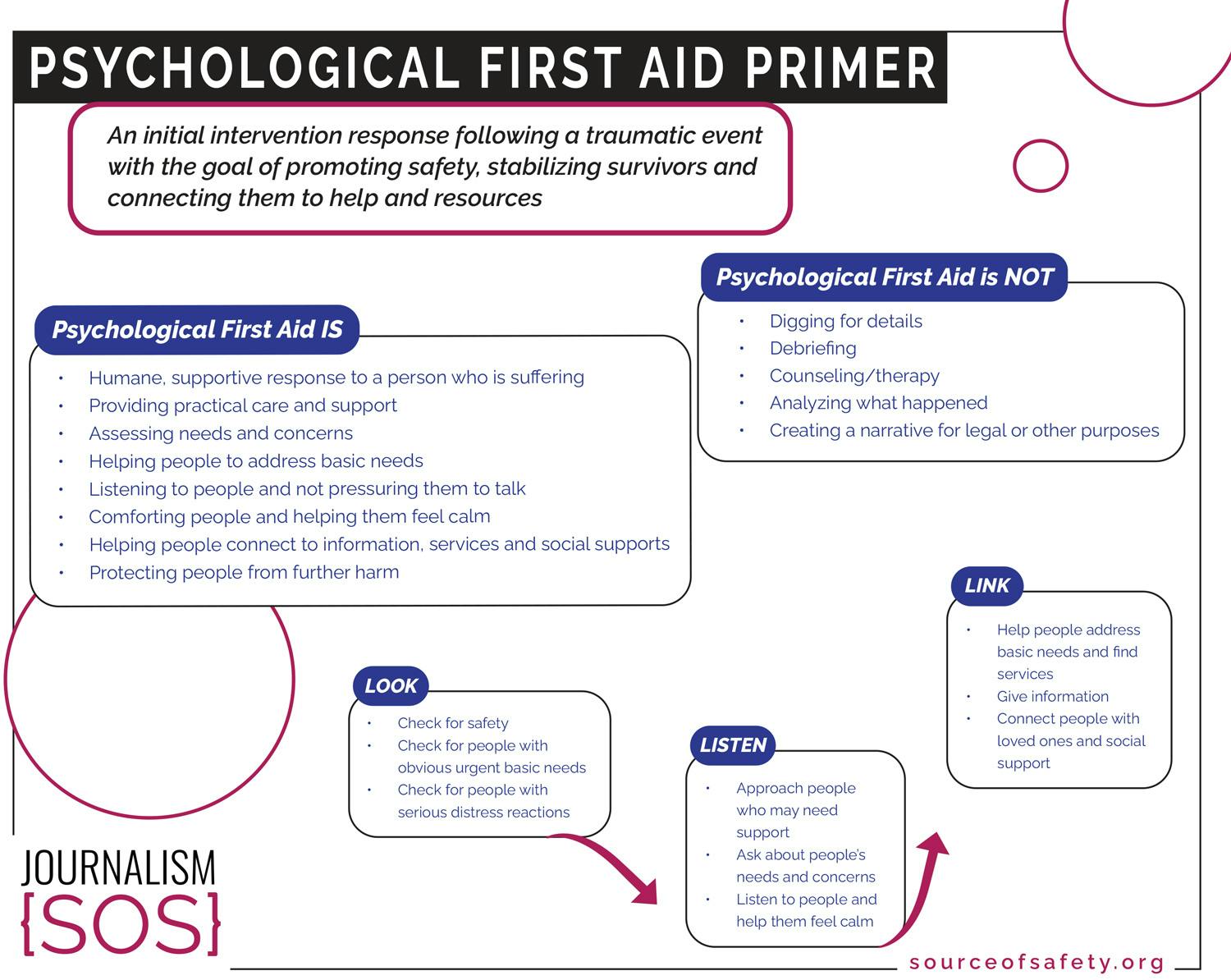
TRAUMA-INFORMED REPORTING BRIEFING
This is a brief overview of some techniques for recognizing and engaging trauma in yourself and others. These communicating practices help us connect thoughtfully with those who have experienced trauma; the grounding techniques and building a self-care practice are frameworks for addressing trauma in ourselves, understanding how to respond to and prepare for our own trauma responses.
The following Top Tips and Resources represent a brief introduction to understanding trauma-informed practices. The information and resources are not comprehensive nor do they offer sufficient preparation for any war or conflict zone. We encourage you to review the more expansive list of resources in the keyword-searchable J-SOS Safety Resource Database and for more information on trauma-informed journalism practices specifically, we recommend the expansive resources offered by the Dart Center for Journalism & Trauma.
Trauma Top Tips
- BUILDING A SELF CARE PRACTICE
Take care of yourself on a social level
-
Have an ‘A Team’ and rely on them: Connecting with others shows us we are not alone in our struggles.
-
Therapy and healing: Allows us to deal with thoughts, behaviors, symptoms, stresses, and experiences in ways that can promote short-term and long-term wellness.
-
Engage in traditions: This anchors us during change and makes space for joy.
-
Ask for what you need: Advocacy strengthens our belief in ourselves.
-
Seek social experiences that are pleasurable: Positive emotions are linked to decreasing stress hormones and building emotional resilience.
-
- BUILDING A SELF CARE PRACTICE
Take care of yourself on a psychological level
-
Mindfulness and breathing: Exercises that bring us to the present moment help connect us back to our bodies
-
Reflection: Allows for insight that can alter the way we see ourselves and the world.
-
Creative expression: Allows us to tap into a “flow state” that soothes the mind and brings positive emotion.
-
Establish routines: Helps us cope with change and create healthy habits.
-
Spend time in nature: The visual cue of peace and nature encourages us to be in this state.
-
Seek counseling: Talking with a therapist or other mental health professional can help you deal with thoughts, behaviors, symptoms, stresses, and experiences in ways that can promote wellness.
-
- INTERVIEWING/DISCUSSION PRACTICES
Create a sense of safety and inspire trust
Ask about their relationship to the physical space: “Is this an OK set up?” “What might help you to feel more comfortable?”
Anticipate their potential needs: “Here’s how I thought we could use our time today.”
Ask permission: “How would that be?”
- INTERVIEWING/DISCUSSION PRACTICES
Help them to feel in control of the situation and conversation
Establish goals: “What would you like to achieve today?”
Talk about talking rather than jumping into directly asking about a triggering experience or event: “What would it be like to talk about X?”
- INTERVIEWING/DISCUSSION PRACTICES
Offer clarity and closure
State any next steps: “I’d like to tell you what I will be doing next."
Ask for feedback: “How did you feel about our work together today?”
Ask them what they are doing next after talking about traumatic events, guiding them to a time and place beyond this moment of engaging their trauma.
Offer praise for the hard work they’ve done by engaging traumatic events or experiences.
- INTERVIEWING/DISCUSSION PRACTICES
Reflect back what you’re hearing
Avoid being analytical or responsive and instead show them they are heard: “I want to make sure that I heard you correctly. Can I tell you what I hear you saying?”
- BUILDING A SELF CARE PRACTICE
Take care of yourself on a biological level
-
Sleep: Getting enough rest (7-9 hours/day) is central to your mental and physical health
-
Nutrition: Eat regularly and choose foods that sustain you well to do the often grueling work of reporting.
-
Exercise: Movement enhances and maintains physical fitness and overall health and wellness
-
Listen to your body: When your body gives you cues like exhaustion, hunger, thirst, etc. take the time to meet those needs so you have the strength and energy required to do this work.
-
Seek physical pleasure: Positive emotions are linked to decreasing stress hormones and building emotional resilience.
-
- GROUNDING TECHNIQUES
Try grounding techniques for yourself or others when experiencing strong or distressful emotions
These are exercises that engage the senses and help refocus to the present moment:
-
Engage the five senses. What can you smell, hear, see, feel, taste?
-
Try progressively relaxing each of your muscles
-
Put a hand on your heart and a hand on your head
-
Take deep breaths, four seconds in and out, four times
-